Robin
Bird BoxRobin is Tom’s daughter, an eight-year-old whose intelligence and attention to small details remain vivid in his memory after her death. She appears in the story through what Tom tells Malorie and through the memories that sustain him during dangerous journeys: a child who found meaning in instructions, film credits, and expressions, and whose absence shapes both his grief and his resolve to protect others.
Identity and Character
Tom remembers Robin as a bright, distinctive child who was already smarter than he had been at her age. Her interests often settled on the parts of things other people might overlook: the instructions for a toy rather than the toy itself, a film’s credits instead of its action, the way a sentence was written, or an expression on her father’s face. These details present her intelligence not as an abstract compliment but as a habit of close attention.
One of Robin’s observations became especially intimate to Tom. She compared his hair to the sun, then told him that he shone more like the moon when it was dark outside. The memory holds the affection and precision that distinguish her in his account: she does not merely praise her father but finds an image that is her own. Tom’s recollection of that remark preserves a particular voice and bond within a narrative world where ordinary domestic life has become difficult to recover.
Robin’s curiosity extended beyond books and appearances. At school, she took part in a science-class dissection and brought home a pig’s eye, keeping it in an open coffee can with pennies. Tom later remembers finding it while searching the house for the source of a smell. The incident gives a concrete expression to her willingness to examine what others might find disturbing, and becomes significant when a later journey forces Tom to encounter the remains of another child.
Childhood During the Crisis
As reports of the catastrophe began to be taken seriously, Tom tried to continue their daily life and to prevent Robin from becoming overwhelmed by fear. He was reluctant to live in fear himself and especially wanted to convey that stance to his daughter, who had already heard frightening reports at school. But ordinary routines began to disappear: parents withdrew their children, Robin’s school closed temporarily, and Tom’s own school also shut its doors. Father and daughter suddenly spent much more time together at home.
Tom tried not to hide the news from Robin, though sometimes he changed the radio station when he felt the reports had become too much. Robin began having nightmares, and he spent time calming her. Their efforts to manage the danger took the form of rules: they agreed not to look out the windows, and Robin was not to go outside without his permission. Tom describes the contradiction those rules had to hold together: he needed to make her believe that things were safe and horribly unsafe at the same time.
The household’s precautions did not restore the old sense of security. Robin began sleeping in Tom’s bed, and shortly before her death she spoke about wanting life to return to how it had been and about missing her mother, whom she had never met. She also expressed the unfairness of her circumstances. Tom later reads that conversation as a possible turning point, the night Robin understood the seriousness of the world outside before he himself fully did. That is his retrospective interpretation, not a certainty about what she thought or why she acted.
Death and Tom’s Grief
The next morning, Tom woke to find Robin gone from his bed. He initially told himself she was adjusting to the new life. He later found her dead in the bathtub, after she had harmed herself with a razor. Her death leaves Tom with an unanswered question: whether she had looked outside or had acted without doing so. The account establishes the uncertainty rather than resolving it; neither Tom nor the reader receives a definitive explanation of her decision.
When Tom tells Malorie what happened, he pauses before disclosing it and acknowledges that telling her may be cruel given her condition. He nevertheless decides that it is a story she needs to know if they are to become acquainted. His account moves from Robin’s bright particularities to the circumstances of her death, making the loss inseparable from the father who recounts it. He emphasizes her age and his enduring inability to know what she saw or understood.
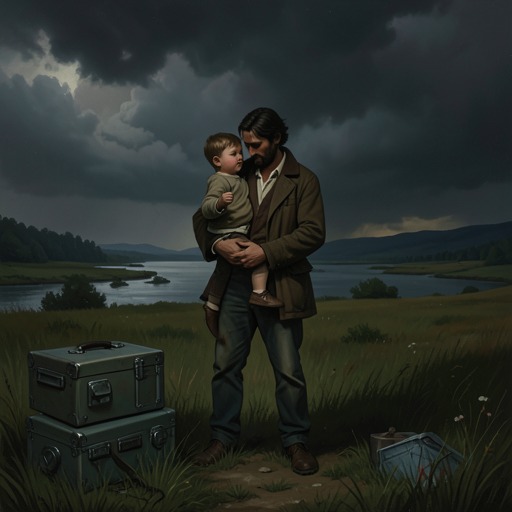
Robin’s memory recurs when Tom must venture beyond the house in search of dogs with Jules. As he steps from the porch and the ground changes from concrete to lawn, he feels the shelter of the house fall away and doubts his ability to continue. He thinks of Robin and reminds himself that he is going to get dogs. The recollection gives his dangerous task a personal focus: he acts for the living, carrying his daughter’s memory into a world where sight and familiar surroundings can no longer be trusted.
The Abandoned House and the Pig’s Eye
During a later search through an abandoned house, Tom encounters the dead boy whose photographs he had seen downstairs. The boy is dressed in a suit and sits propped against a headboard. Tom recognizes from the scene that the child had died there, apparently from starvation, and wonders how long he had been dead and how close he had come to finding him in time. The encounter turns Tom’s thoughts toward Robin; he silently apologizes to her.
The sight of the boy is not the only reminder. In another room, Tom touches a thick substance in a bowl and connects it to what he had once felt at the edge of Robin’s bathtub. The association is triggered by touch, not by a new revelation about Robin’s death. Likewise, when he touches the pig’s eye, he remembers the coffee can of pennies and Robin’s science-class dissection. These two memories connect the intimate details of her life with the dangers and abandoned households of the present, while distinguishing a child’s curiosity from the violence and deprivation surrounding the survivors.
Narrative Role
Robin is not present as an active participant in the catastrophe’s later events, but the novel gives her continuing force through Tom’s memories. Her story complicates his attempt to protect others: before the shared crisis, he had tried to keep his daughter safe by maintaining routines, managing what she heard, and restricting where she could go, yet those measures could not make the household secure or explain her death. The limits of his knowledge remain part of his grief.
Her recollection also provides Tom with a reason to move when the outside world makes movement frightening. Thinking of Robin helps him leave the porch and pursue the practical goal of finding dogs. In the abandoned house, the dead boy and the remembered pig’s eye return him to her absence. The recurring memories do not undo that loss; they show how it travels with Tom, linking paternal tenderness, unresolved sorrow, and the continuing work of survival.